How to care for watercress (indoors)

Written by Jon Persson, partner and designer at Herbs at Home
Published · Updated · 4 min read
Some links below go to Amazon. If you buy through one, we earn a small commission at no extra cost to you.

Watercress in short
A water-loving perennial with a peppery bite, and one of the few herbs that genuinely wants to sit in water. Refresh the water regularly to avoid algae.
- Light
- Full sunSunniest window, or 14 hours under a grow light
- Water
- Standing waterConstant. Grow in standing water, refreshed regularly
- Temperature
- 50–70°F
- Difficulty
- Beginner
What usually goes wrong
Water turns cloudy and starts to smell, stems go slimy at the base
Fix: Change the water every day or two, twice a day in a warm room. Keep the tray shallow and in the coolest bright spot available, and pull out any soft stems before they take the rest with them.
Watercress (Nasturtium officinale) is a semi-aquatic perennial that grows wild in cold running streams.[1] Almost everything that goes wrong with it indoors comes from the running part. Standing water goes stagnant, roots suffocate, algae takes hold, and the plant turns slimy at the base.
Keep the water moving or keep changing it, and watercress is one of the easiest things you can grow on a windowsill.
Our guide to growing new watercress plants covers starting from seed and cuttings. This post covers keeping them going.
Water
This is the one thing to get right. Watercress wants its roots wet permanently, which is the opposite of every other herb we write about, and it will not forgive drying out.
Stand the pot in a saucer or tray with an inch or two of water in it and let the plant drink from below. Topping up from the top compacts the growing medium over time and washes the surface bare.
Change that water every one to two days. Water sitting still for a week grows bacteria and algae, and the first sign is usually a faint sour smell rather than anything visible. Rinse the tray when you refill it rather than just topping it up.
If you are growing hydroponically, an air stone or a small pump does the same job continuously and is worth the few dollars. Moving, oxygenated water is closer to a stream than anything a tray can offer, and plants grown that way stay productive noticeably longer.
Tap water is fine. Very hard or heavily chlorinated water is worth leaving to stand overnight first.
Light and temperature
Give watercress your sunniest window, ideally one facing south. In summer, hot sun through glass can warm a small tray of water, so pull the pot back from the glass at midday if the water feels warm.
If natural light is short, about 14 hours a day under an LED or fluorescent grow light positioned 6 to 12 inches above the plants covers it.
Watercress grows best between 60 and 70°F, and keeps growing more slowly below that. It tolerates ordinary room temperature and responds to real warmth by bolting: sending up a flower stalk, after which the leaves turn bitter and peppery in a way most people dislike. A cooler window in summer buys you weeks of extra harvesting.
Turn the pot every few days so growth stays even.
Feeding
Watercress does not need much. In soil with any organic matter in it, or in a hydroponic setup with a nutrient solution, it will often need nothing at all.
If growth pales or slows, use a water-soluble fertilizer at less than half the strength on the label, every few weeks. Full-strength feed burns the fine roots, and because those roots sit permanently in water there is no dry period to flush the salts away.

Neptune’s Harvest seaweed plant food, 0-0-1 (pint)
- Cold-processed from Ascophyllum nodosum, a North Atlantic kelp
- NPK 0-0-1, so it supplements a feed rather than replacing one
- Dilute before use; mixes without sediment and has very little smell
Pruning and harvesting
Cutting watercress is the same operation as harvesting it, and doing it regularly is what keeps the plant compact and productive.
Cut when the plants reach 4 to 6 inches, taking them back to about 4 inches with clean scissors or by pinching the tips. Take the leggy, overgrown stems first. Frequent light cuts produce a bushier plant than occasional hard ones.
Cut out any flower stalks as soon as you see them. Once watercress flowers it puts its energy into seed and the leaves turn bitter, and removing the stalks early buys another few weeks of usable leaves.
A well-managed plant keeps producing for several months before it needs replacing. Our pruning guide covers the general technique.
Common problems
Slimy roots or a foul smell. The water has gone stagnant. Change it every one to two days, scrub the tray or container when you do, and add an air stone if you are growing hydroponically. This is by far the most common watercress failure.
Yellowing leaves. Usually nitrogen shortage, occasionally water quality. Feed at quarter strength and see whether new growth comes in green. In hydroponics, check the pH is between 6.5 and 7.5, since watercress takes up nutrients poorly outside that range even when the nutrients are present.
Leggy, stretched growth. Not enough light. Move it closer to the window or add hours under a lamp, and cut the stretched stems back to force bushier regrowth.
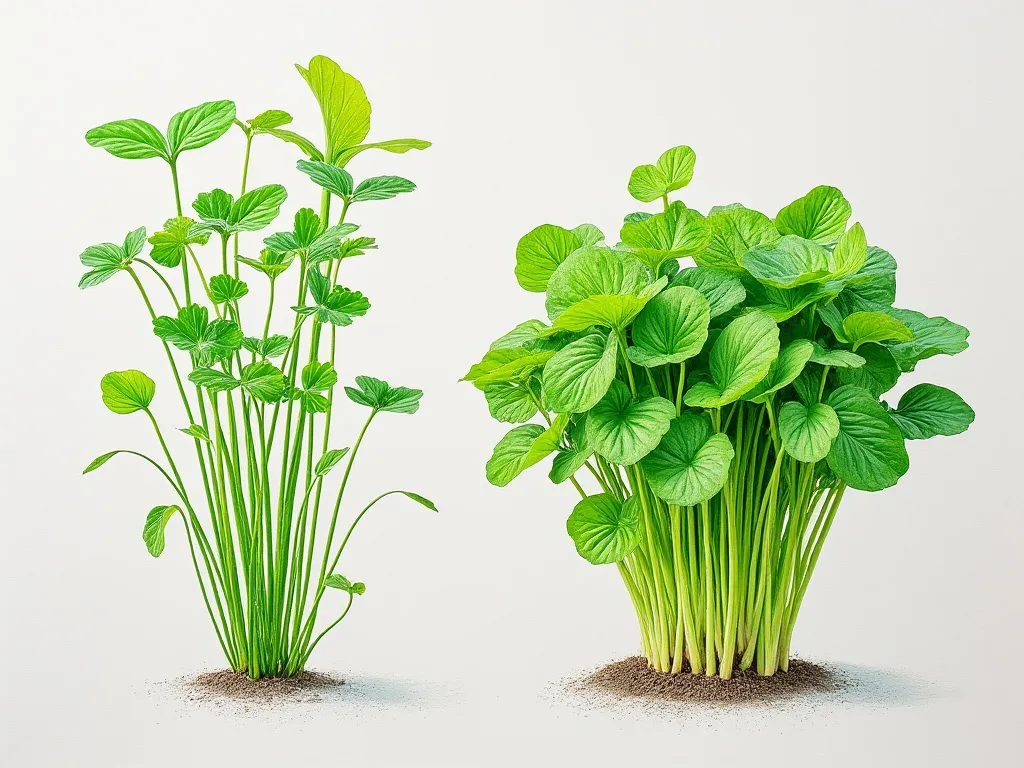
Stunted growth. Either light or air. Give it more light and stop crowding it against other pots so air can move through the foliage.
Algae on the surface. Green film on the growing medium or tray means light is reaching standing water. Change the water more often, and if you are using a clear container, wrap it or swap it for an opaque one. Algae competes with the plant for oxygen and nutrients.
Mold on the soil. Too much moisture at the surface with too little airflow. Scrape off the affected layer, replace it with fresh medium, and get some air moving with a small fan.
Aphids, spider mites and whiteflies. Check the undersides of the leaves weekly. Watercress is harvested young and eaten raw, so stick to insecticidal soap or a few drops of dish soap in water and rinse well before eating. Our indoor pest guide covers heavier infestations.
References
-
Michigan State University Extension, “Watercress: a nutritious early spring green.” https://www.canr.msu.edu/news/watercress_a_nutritious_early_spring_green ↩︎


