What is perlite? What it is made of, and what it is good for

Written by Amanda Shiffler, M.Sc. Agronomy, B.Sc. Horticultural Science
Published · Updated · 9 min read
Some links below go to Amazon. If you buy through one, we earn a small commission at no extra cost to you.

Perlite is a volcanic glass containing 2 to 5 percent trapped water. Heated to around 900°C, that water flashes to steam and pops each granule like popcorn, four to twenty times its original volume, into the white, foam-textured specks in potting mix.[1] Its job in a pot is physical: it drains, it aerates, and it does not compact. Chemically it gives a plant nothing at all, near-neutral pH, negligible cation exchange, no nutrients,[2] which is exactly why it never upsets the rest of a mix.
The little white balls in potting soil get mistaken for styrofoam constantly, and the confusion is fair: they are light, they cling to everything with static, and they float to the surface of a watered pot. They are rock. Understanding what kind of rock explains everything perlite does and does not do.
What perlite is made of
Perlite starts as an amorphous volcanic glass, formed where obsidian takes up water over geological time.[1] By composition it is mostly silica, 65 to 80 percent SiO₂, with 8 to 18 percent aluminium oxide and small amounts of sodium and potassium oxides.[3] The ingredient that matters is the least glamorous one: 2 to 5 percent combined water locked inside the glass. Volcanic glass with less than about 2 percent water is just obsidian; with the water, it is perlite, and it can be popped.
It is mined, not manufactured. China and Turkey lead world production, with Greece third and the United States fourth at about 460,000 tonnes a year from nine mines across six western states, New Mexico first among them. Greece holds the largest reserves and supplies nearly all US imports.[4] Horticulture takes only about 15 percent of US perlite; most of the rest goes into building products, and it also filters beer and stormwater.[4]
How the popcorn step works
Crude perlite arrives at an expansion plant as unremarkable grey gravel. Heated rapidly past 1,600°F, around 870 to 1,100°C, the glass softens just as the trapped water vaporizes, and each particle inflates into a cellular white foam of sealed and half-sealed bubbles, four to twenty times its starting volume.[1] The white colour is not a pigment; it is light scattering off millions of tiny glass bubbles, the same reason sea foam is white.
The result weighs 5 to 8 pounds per cubic foot in horticultural grades,[3] holds water on its pocked surface rather than inside its body, and, being glass, never rots, shrinks or compresses in the pot.
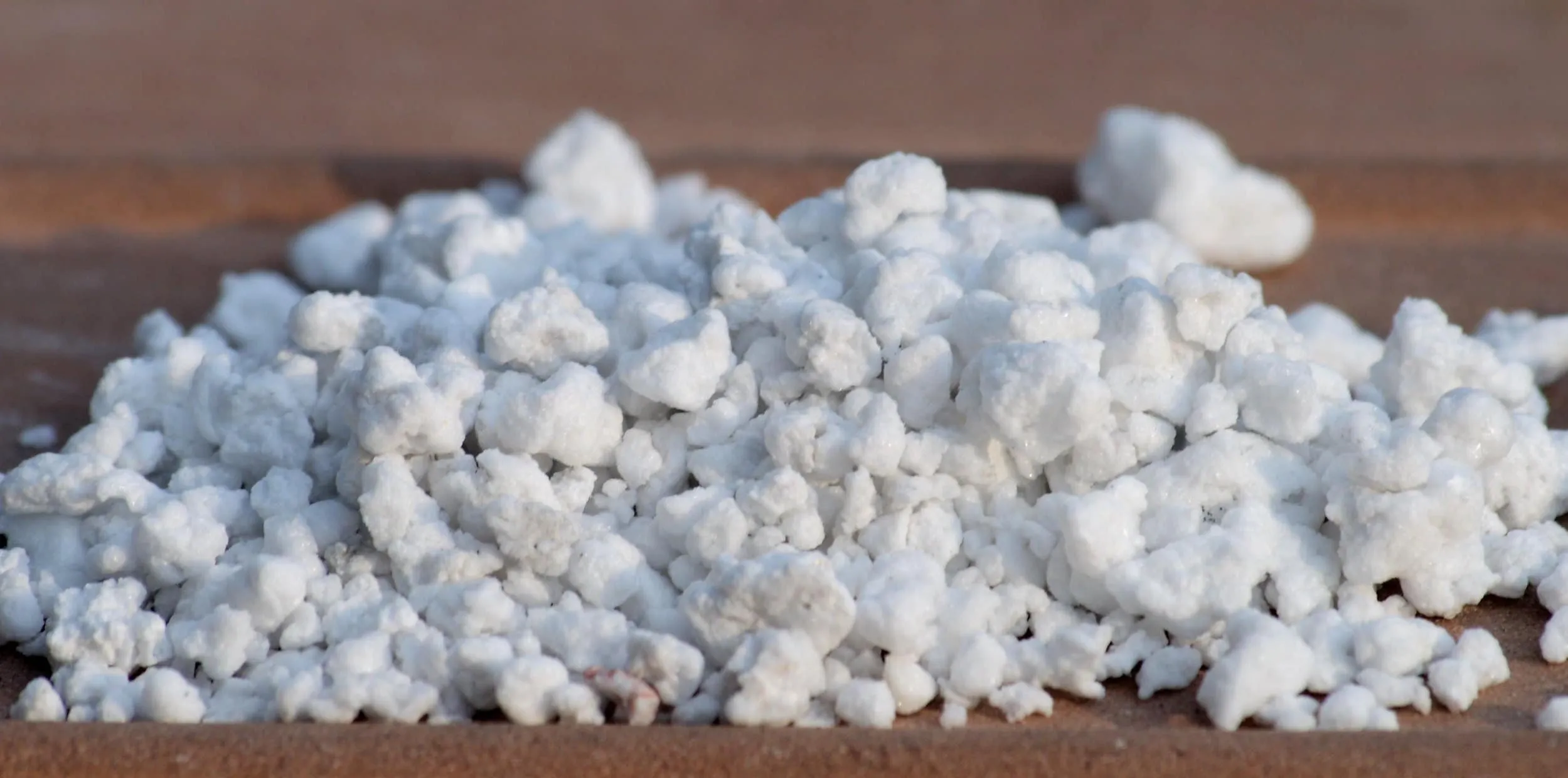 Close up of crushed perlite.
What perlite does in a pot
A container substrate has two jobs that pull against each other: hold water for the roots, and hold open air passages so those roots can respire. Peat, coir and compost do the first job well and slump toward airlessness over a season. Perlite is the counterweight. In peat-based mixes, moving from fine to coarse perlite at the same ratio swings air-filled porosity from around 21 percent to 46 percent,[5] with the desirable range for containers sitting at 15 to 25 percent. A measured horticultural grade runs about 63 percent total pore space, split roughly 38 percent water-holding and 25 percent air even when saturated.[2]
Just as useful is what it refuses to do. Perlite is chemically inert: pH 7.0 to 7.5, negligible cation exchange capacity, and only trace minerals, none meaningfully available to plants.[2] You will read that perlite “contains minerals plants need,” and it is technically true of the glass and horticulturally false in the pot; anything growing in perlite lives entirely on what you feed it, which is why the Perlite Institute’s own growing guides tell you to add fertilizer. It arrives sterile from the 900-degree furnace, carries no weed seed or pathogens, and will not shift the pH of whatever you blend it into.
If you want the fuller picture of how it compares across substrates, our growing media guide puts perlite alongside coir, peat and the rest.

The enthusiast’s guide to herbs
In-depth care cards for the 35 herbs people most often grow indoors.
See what’s insideChoosing a grade
Horticultural perlite is screened into grades, coarse through extra fine, and the rule is simple: the coarser the particle, the more aeration and drainage; the finer, the more moisture it holds and the less air it adds.[6] The old habit of quoting exact water-holding percentages per grade has quietly disappeared from the industry’s own literature, so buy on the principle rather than the decimals:
- Coarse for succulents, orchid mixes, and any pot you habitually overwater. It resists floating to the surface better than fine grades and does the most for drainage per handful.
- Medium, the common bagged grade, for general potting mixes and container herbs.
- Fine and extra fine for seed starting and rooting cuttings, where you want moisture held evenly around small roots with gentle aeration rather than big air gaps.
Espoma’s organic perlite is a reliable medium horticultural grade and the one we reach for.
How to use it with herbs
- In a potting mix, the standard move: blend one part perlite to two or three parts peat- or coir-based mix. The Mediterranean herbs that hate wet feet, rosemary, thyme, sage, oregano, lavender, marjoram, are the ones to be generous with.
- For seed starting and cuttings, alone or half-and-half with coir. It is sterile, so damping-off pressure starts at zero, and seedlings pull out of it without tearing roots.
- As the whole medium in hydroponics. Perlite fills Dutch buckets and grow bags on its own, and cuttings root well in 100 percent perlite kept just moist.[7]
- Reused, season after season. Perlite does not decompose, and growers run it through multiple crop cycles; between plants, rinse out the old roots and disinfect, a hot-water soak above 71°C is the studied method, which cut substrate costs by three quarters in commercial trials.[8]
The herbs that want constant moisture, basil, parsley, cilantro, mint, still belong in mixes where perlite is the minority partner; give the water retention job to coir or peat and let perlite keep the bottom of the pot breathing.
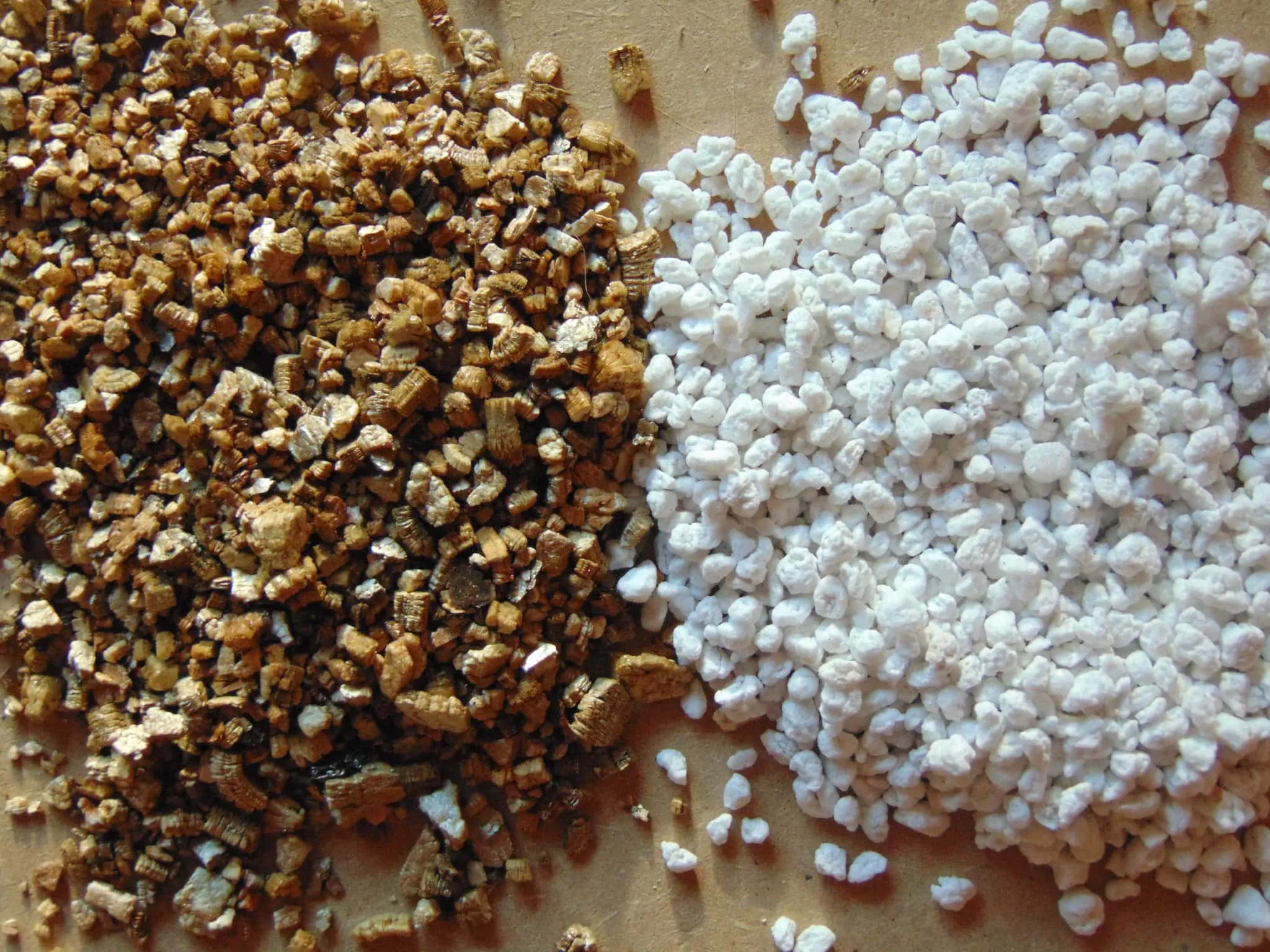 Vermiculite vs Perlite
Perlite versus vermiculite
The gold-brown accordion flakes in bagged mixes are vermiculite, and gardeners swap the names as if the two were interchangeable. They are opposites in the one dimension that matters. Perlite is a drainage amendment: rigid glass, water held on the surface, air pockets that survive watering. Vermiculite is a retention amendment: it soaks water up between its plates and holds onto nutrients too, with a real cation exchange capacity of 10 to 23 meq/100 g and a pH that runs neutral to distinctly alkaline depending on the mine, 7.0 to 8.0 for US sources and up to 9.0 for African ones.[2]
Use perlite for plants that want to dry out between waterings, vermiculite for plants that want staying damp, and both, in tension, in general-purpose mixes. Diatomaceous earth, the other white powder in the amendment aisle, is no substitute for perlite either: it is moisture-retentive, and as a fine powder it clumps when wet and fills exactly the pores perlite exists to hold open.
Is perlite safe?
Handled sensibly, yes, and the record is unusually clean. Expanded perlite is amorphous glass, not crystalline silica: measured quartz content runs around 0.4 percent, far below the 1 percent regulatory threshold for silica-hazard classification, and decades of worker-health monitoring in perlite plants have produced no reports of adverse effects.[9] It is a nuisance dust rather than a toxic one. It is still a dust, so wear a mask when pouring a large bag and dampen it before mixing, which kills the dust entirely.
Two clarifications the search results get wrong. Perlite has no asbestos problem; the contaminated-insulation story people half-remember belongs to vermiculite from the Libby, Montana mine, a different mineral from a different place. And the one genuine agronomic caveat is niche: perlite can carry traces of fluoride, which matters only for a handful of fluoride-sensitive foliage plants like dracaenas and spider plants,[10] and not for herbs.
Questions & answers
Is perlite styrofoam?
No. It looks and floats like styrofoam but it is expanded volcanic glass, mined rock heated until its trapped water pops it into foam. The practical differences: perlite is fireproof, does not break down, and crushes to gritty powder between your fingers rather than denting.
Is perlite toxic to plants, pets or people?
No. It is chemically inert, essentially free of crystalline silica, and decades of occupational health studies in perlite plants report no adverse effects.[9] The only real precaution is the mundane one: it is dusty, so wet it down or wear a mask when handling quantity.
Can I grow plants in just perlite?
Yes, and commercial growers do: Dutch-bucket hydroponic tomatoes and cucumbers grow in pure perlite, and it is a first-rate medium for rooting cuttings.[7] The catch follows from its chemistry: perlite contains nothing to eat, so anything growing in it long-term needs a complete liquid feed.
Does perlite decompose or wear out?
No. It is glass, so it neither rots nor compresses, and the same perlite can serve for years if you rinse the roots out and disinfect it between crops.[8] What does happen is mechanical: rough handling crushes granules into dust, and the dust fraction holds water rather than air, so sieve out the fines when reusing old perlite.
Why does perlite float to the top of my pots?
It weighs 5 to 8 pounds per cubic foot against water’s 62, so hard watering rafts it upward through the mix. It is cosmetic rather than harmful. Coarser grades migrate less, watering gently helps, and a thin top-dressing of mix hides the rest.
Is perlite or vermiculite better for herbs?
For the Mediterranean herbs, rosemary, thyme, sage, oregano, lavender, perlite, because they die of wet feet, not thirst. For moisture-lovers like basil and mint, lean on vermiculite or coir for retention and keep perlite as a smaller share for aeration. Most bagged mixes hedge by including both, which is the right instinct.
Perlite is one corner of the substrate picture. How it fits with coconut coir, peat moss and vermiculite is covered in our growing media guide, and if your problem is a mix that never dries out, start with our guide to root rot.

Ten printable herb cards, free
One card per herb: how much light and water it wants, and what goes wrong first.
Get them nowReferences
-
Perlite Institute. Everything you need to know about the origins of perlite and Perlite as an absorbent carrier (expansion above 1600°F / 870°C, four to twenty times original volume). https://www.perlite.org/everything-you-need-to-know-about-the-origins-of-perlite/ ↩︎ ↩︎ ↩︎
-
University of Arkansas, Greenhouse Production course, Unit 7: Growing Media. Perlite: pH 7.0–7.5, chemically inert, negligible CEC, trace nutrients only; measured 63% total pore space, 38% water-holding, 25% air-filled porosity. Vermiculite: CEC 10–23 meq/100 g, pH 7.0–8.0 (US) to 9.0 (African). https://greenhouse.hosted.uark.edu/Unit07/Section05.html ↩︎ ↩︎ ↩︎ ↩︎
-
USDA Agricultural Marketing Service (2024). Technical evaluation report: Perlite, handling/processing. Composition ranges and bulk density of horticultural grades. https://www.ams.usda.gov/sites/default/files/media/2024TechnicalReportPerliteHandling.pdf ↩︎ ↩︎
-
US Geological Survey (2026). Mineral Commodity Summaries 2026: Perlite. 2025 production estimates. https://pubs.usgs.gov/periodicals/mcs2026/mcs2026-perlite.pdf ↩︎ ↩︎
-
Perlite Institute. Perlite gradation in peat/perlite mixtures. Free porosity 21% (fine) to 46.1% (coarse) at 75% perlite. https://www.perlite.org/wp-content/uploads/2018/03/perlite-gradation-peat-perlite-mixtures.pdf ↩︎
-
Perlite Institute (2025). Everything you need to know about perlite for horticulture. Coarser than 12 mesh: more aeration; finer: more moisture retention. https://www.perlite.org/wp-content/uploads/2025/10/Everything-You-Need-to-Know-About-Perlite-for-Horticulture.pdf ↩︎
-
Perlite Institute. The role of perlite in hydroponic culture. https://www.perlite.org/the-role-of-perlite-in-hydroponic-culture/ ↩︎ ↩︎
-
Hanna, H. Y. (2006). Recycling perlite for greater greenhouse tomato profits. Journal of Vegetable Science, 12(1). https://doi.org/10.1300/J484v12n01_05 ↩︎ ↩︎
-
NIOSH, OSHA PEL project documentation for perlite: essentially amorphous; ~0.4% quartz and ~0.2% cristobalite in processed perlite; no published reports of adverse physiological effects. https://www.cdc.gov/niosh/chemicals/pel88/pell-pages/perlite.html ↩︎ ↩︎
-
Pacific Northwest Pest Management Handbooks. Fluorine toxicity in plants (sensitive species), with perlite named as a potential fluoride source in University of Arkansas substrate guidance. https://pnwhandbooks.org/plantdisease/pathogen-articles/nonpathogenic-phenomena/fluorine-toxicity-plants ↩︎


