What is vermiculite? What it does in a pot, and whether it is safe

Written by Amanda Shiffler, M.Sc. Agronomy, B.Sc. Horticultural Science
Published · Updated · 9 min read
Some links below go to Amazon. If you buy through one, we earn a small commission at no extra cost to you.

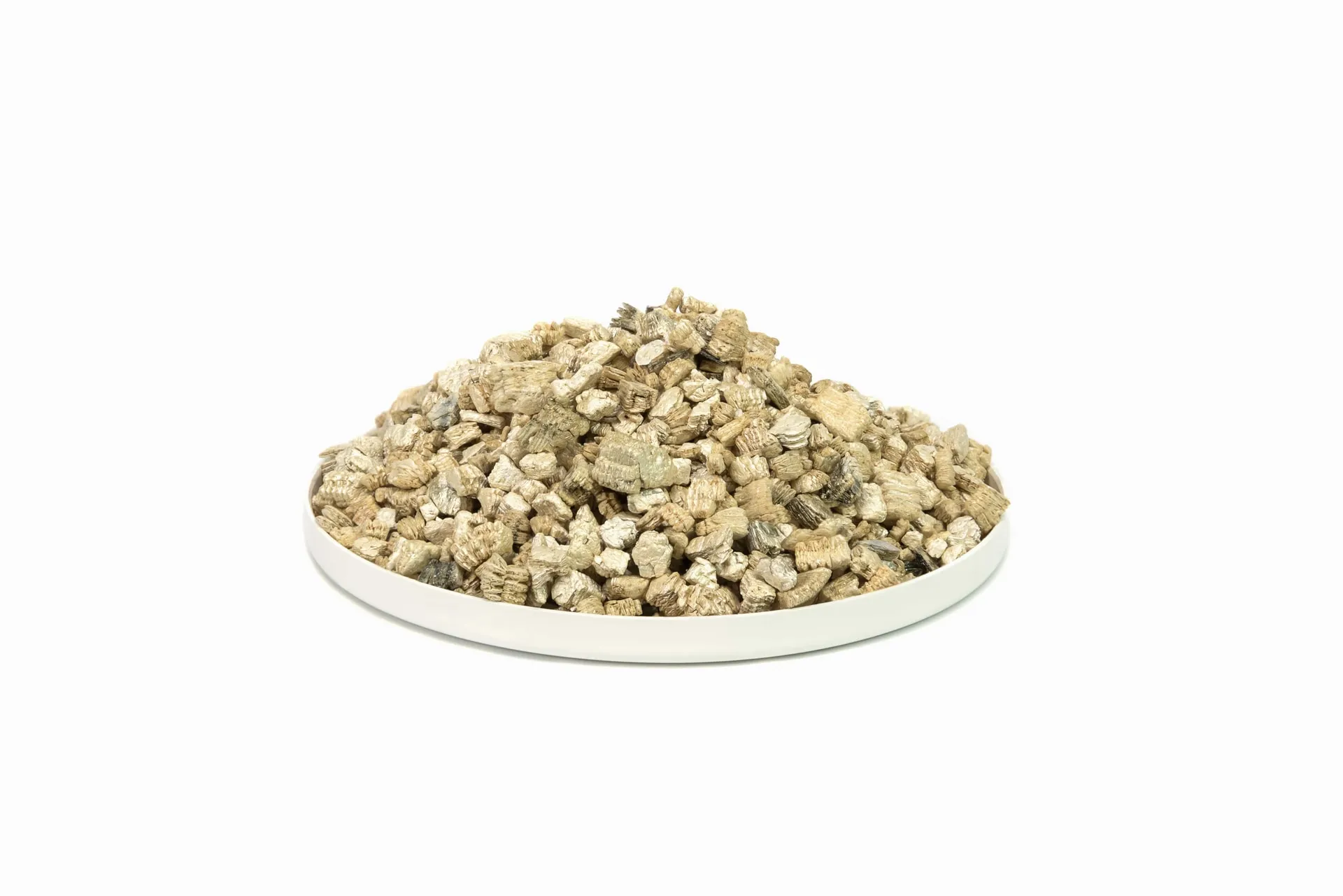
Vermiculite is a mica-family mineral that puffs into golden, accordion-shaped flakes when flash-heated at around 900°C.[1] In a pot it is the opposite number to perlite: it soaks up two to three times its weight in water, holds nutrients on a real cation exchange capacity, and slowly contributes potassium, magnesium and calcium of its own.[2] Use it where you want moisture held, seed starting above all. On safety: the asbestos-contaminated mine behind the old headlines closed in 1990, and EPA testing of modern garden vermiculite found most products had no measurable asbestos; handle it damp and in ventilated space and the remaining risk is managed.[3]
The gold flecks in a bag of potting mix are vermiculite, and most gardeners file them as decoration. They are doing a specific job, one the white perlite specks beside them cannot do, and knowing the difference is most of what there is to know about building a potting mix.
What vermiculite is
Vermiculite is a hydrated magnesium-aluminium-iron silicate from the mica family, formed underground as biotite and phlogopite micas weather and take on water. Chemically it runs 38 to 46 percent silica, 16 to 35 percent magnesium oxide and 10 to 16 percent alumina, with 8 to 16 percent bound water,[4] and that water is the working ingredient, just as it is in perlite.
Mined ore is screened into grades before expansion; the common horticultural sizes run 0–2, 2–4 and 4–8 mm.[5] World supply today comes mostly from South Africa, the United States, where two companies mine it in South Carolina and Virginia, and Brazil.[6] The largest single use of the expanded product is agriculture.[6]
How it puffs
Expansion is a furnace trick the industry calls exfoliation. Crude vermiculite is flash-heated at roughly 900°C for a few minutes; the bound water flashes to steam, and trapped between the mineral’s layered plates, it jacks them apart so each particle unfolds like an accordion, up to 20 to 30 times its original thickness in the classic descriptions.[1] The result is featherweight, 4 to 10 pounds per cubic foot,[4] riddled with wick-like channels, and sterile straight out of a 900-degree oven.
What it does in a pot
Everything vermiculite is good at follows from two measured properties.
It holds water like a sponge. Expanded vermiculite absorbs 220 to 325 percent of its own weight in water,[4] and unlike perlite, which carries water only on its surface, vermiculite holds it between the plates and releases it gradually. In a mix, that is the difference between a pot that needs water daily and one that coasts through a weekend.
It holds food as well as water. Vermiculite has a genuine cation exchange capacity, 10 to 23 meq/100 g,[2] so dissolved nutrients stick to it instead of washing out of the drainage holes, and the mineral itself supplies potassium, magnesium and some calcium as it weathers.[7] Perlite, by contrast, is inert glass that contributes nothing. Neither behaviour is better; they are different tools.
One chemical note: vermiculite runs neutral to alkaline, pH 7.0 to 8.0 for US sources and up to 9.0 for African material.[2] In a peat-based mix that is a feature, nudging the blend toward neutral. For acid-loving plants it is a reason to keep vermiculite a minority ingredient.
The catch: it collapses
Perlite is rigid glass and holds its structure for years. Vermiculite is a stack of soft mineral plates, and under the weight of wet mix, watering and handling, the accordion gradually flattens. Arkansas’s greenhouse course is blunt about it: the particle is fragile, compresses in the substrate over time, and loses its ability to hold open air space.[2] It never rots, it is rock, but it expires structurally.
Two practical consequences. Do not count on vermiculite for aeration in a mix that will run more than a season; that is perlite’s job. And do not recycle old vermiculite expecting year-one performance; what pours out of last year’s pot is flatter and wetter-natured than what went in.

The enthusiast’s guide to herbs
In-depth care cards for the 35 herbs people most often grow indoors.
See what’s insideVermiculite versus perlite
The pairing question, settled in one paragraph: perlite drains, vermiculite retains, and they are complements rather than substitutes.[2] Perlite’s rigid pores keep a mix breathing; vermiculite’s soft plates keep it moist and fed. The Mediterranean herbs that hate wet feet, rosemary, thyme, sage, lavender, want the perlite side of the ledger. The moisture crowd, basil, parsley, cilantro, mint, benefits from vermiculite’s buffer. Most bagged mixes carry both, in tension, on purpose. Our perlite guide makes the same argument from the other side, and the growing media guide puts both alongside coir and peat.
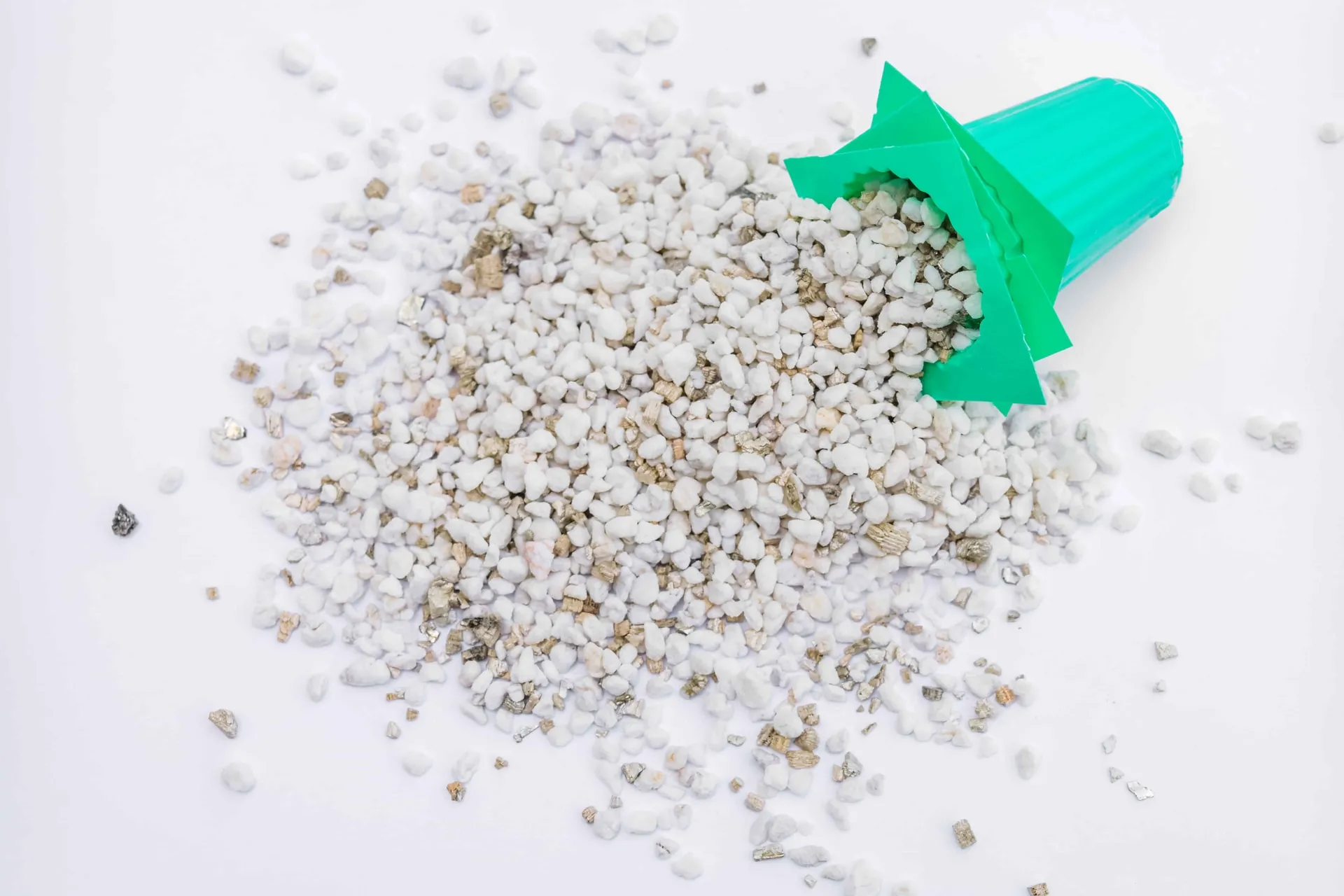 Vermiculite and perlite, doing opposite jobs in the same mix.
How to use it
- Seed starting is vermiculite’s best event. Fine-grade vermiculite alone germinates seeds well: sterile, moisture-steady, and loose enough that new roots meet no resistance.[8] Its second trick is as a covering layer; a thin screen of fine vermiculite over small seeds holds moisture against them without ever crusting the way soil does.[9]
- Rooting cuttings. The same virtues apply; vermiculite and perlite, alone or half-and-half, are the standard propagation media.[10]
- In potting mixes, as the moisture-and-nutrient buffer, typically a quarter to a third of the blend alongside perlite and a base of peat or coir.
- Storing tender bulbs. Dahlias, cannas and other tender bulbs overwinter packed in vermiculite in a perforated bag at 45 to 50°F; it absorbs excess moisture without desiccating the bulbs.[11]
Espoma’s 8-quart organic vermiculite is a reliable horticultural grade, and both big-box chains now stock house brands, so the old complaint that vermiculite is hard to find retail no longer holds.
Is vermiculite safe? The asbestos question, answered properly
Vermiculite carries a reputation problem it mostly no longer deserves, and the story is worth telling straight because the details matter.
From 1919 to 1990, over 70 percent of the vermiculite sold in the United States came from one mine in Libby, Montana, and that deposit was laced with a naturally occurring amphibole asbestos now called Libby Amphibole.[3] The contamination reached workers, the town, and products, most notoriously Zonolite attic insulation. The mine closed in 1990, and the cleanup became one of the EPA’s largest and longest-running Superfund projects. If your house has old vermiculite attic insulation, the EPA’s instruction is unambiguous: assume it contains asbestos, do not disturb it, and bring in a licensed professional for any renovation that touches it.[3]
Garden vermiculite today is a different product from different rock. Current supply comes from South Carolina, Virginia, South Africa and Brazil,[6] and when the EPA tested consumer garden vermiculite nationwide, most products contained no asbestos it could reliably quantify, 8 of 54 samples did, at levels the agency judged a minimal health risk for routine gardening use.[12] Its handling advice stands and costs nothing to follow: use vermiculite outdoors or in a well-ventilated space, keep it damp while you work to hold down dust, and avoid tracking dry dust indoors on clothing.[12] The dust you are suppressing is mostly nuisance mineral dust; dampening it addresses the residual concern entirely.
That is the whole picture: a real historical tragedy tied to one closed mine, a modern supply chain that tested largely clean, and a two-step handling habit that closes the gap.
Questions & answers
Does vermiculite contain asbestos today?
The contaminated source, the Libby, Montana mine, closed in 1990. EPA testing of modern retail garden vermiculite found most products had no reliably measurable asbestos, and judged routine garden use a minimal risk.[12] Today’s supply comes from South Carolina, Virginia, South Africa and Brazil.[6] Handle it damp and ventilated and you have covered the residual concern.
What is the safe way to handle vermiculite?
Open the bag outdoors or in a well-ventilated space, moisten it before mixing so it cannot dust, and do not carry dry dust indoors on your clothes.[12] Damp handling also happens to be more pleasant; dry vermiculite is flyaway stuff.
Which is better, vermiculite or perlite?
Neither; they do opposite jobs. Perlite is rigid, inert glass that drains and aerates permanently. Vermiculite is a soft mineral sponge that holds water and nutrients and slowly feeds potassium and magnesium, then compresses over a season or two.[2] Drought-lovers get perlite-heavy mixes, moisture-lovers get vermiculite, and general mixes carry both.
Can you start seeds in pure vermiculite?
Yes, and it is one of the best uses for it. Fine-grade vermiculite alone is sterile, holds even moisture, and lets seedlings lift out for transplanting without root damage.[8] It carries no nutrition beyond its trace potassium and magnesium, so begin dilute feeding once true leaves appear, or transplant promptly.
Does vermiculite go bad or break down?
Chemically, never; it is rock and cannot rot. Structurally, yes: the soft accordion particles compress under watering and handling until they stop holding air.[2] Treat it as a one-to-two-season ingredient for structure purposes, and expect reclaimed vermiculite to behave wetter and denser than fresh.
Should I worry about old vermiculite insulation in my attic?
Treat it with respect. Attic vermiculite installed before 1990 very likely came from the contaminated Libby mine, and the EPA’s guidance is to assume it contains asbestos, leave it undisturbed, and use licensed asbestos professionals for any work that would touch it.[3] That is a household issue, not a gardening one; do not move attic insulation to the garden, obviously.
Vermiculite is one corner of the substrate picture. Its opposite number is covered in our perlite guide, the organic side lives in the coconut coir and peat moss guides, and the growing media guide puts the whole toolkit side by side.

Ten printable herb cards, free
One card per herb: how much light and water it wants, and what goes wrong first.
Get them nowReferences
-
Hillier, S., Marwa, E. M. M. and Rice, C. M. (2013). On the mechanism of exfoliation of ‘Vermiculite’. Clay Minerals, 48(4), 563–582. Flash heating around 900°C; expansion “up to 20–30 times” in the classic descriptions. https://doi.org/10.1180/claymin.2013.048.4.01 ↩︎ ↩︎
-
University of Arkansas, Greenhouse Production course, Unit 7: Growing Media. Vermiculite CEC 10–23 meq/100 g; pH 7.0–8.0 (US sources) to 9.0 (African); fragile particles compress in the substrate over time and lose air-filled pore space. https://greenhouse.hosted.uark.edu/Unit07/Section05.html ↩︎ ↩︎ ↩︎ ↩︎ ↩︎ ↩︎ ↩︎
-
US Environmental Protection Agency. Protect your family from asbestos-contaminated vermiculite insulation: the Libby mine supplied over 70% of US vermiculite from 1919 to 1990 and closed in 1990; assume old vermiculite insulation contains asbestos and do not disturb it. https://www.epa.gov/asbestos/protect-your-family-asbestos-contaminated-vermiculite-insulation ↩︎ ↩︎ ↩︎ ↩︎
-
The Vermiculite Association. Vermiculite data sheet: chemical composition ranges, water absorption 220–325% by weight, bulk density 64–160 kg/m³. https://www.vermiculite.org/wp-content/uploads/2014/09/Vermiculite-Data.pdf ↩︎ ↩︎ ↩︎
-
Bar-Tal, A., Saha, U. K., Raviv, M. and Tuller, M. (2019). Inorganic and synthetic organic components of soilless culture and potting mixtures. In Soilless Culture, 2nd ed. Elsevier. https://doi.org/10.1016/B978-0-444-63696-6.00007-4 ↩︎
-
US Geological Survey (2026). Mineral Commodity Summaries 2026: Vermiculite. 2025 production estimates; US mining in South Carolina and Virginia; agriculture the largest end use. https://pubs.usgs.gov/periodicals/mcs2026/mcs2026-vermiculite.pdf ↩︎ ↩︎ ↩︎ ↩︎
-
Texas A&M AgriLife Extension, Greenhouse Management: growing media. Vermiculite offers excellent exchange and buffering capacities and supplies potassium and magnesium. https://aggie-horticulture.tamu.edu/ornamental/greenhouse-management/growing-media/ ↩︎
-
University of Missouri Extension, G6570. Starting plants from seed: fine vermiculite is well suited to seed germination and, used as a cover, does not crust. https://extension.missouri.edu/publications/g6570 ↩︎ ↩︎
-
Purdue Extension, HO-14-W. Starting seeds indoors: screen a thin layer of fine vermiculite over small seeds. https://www.extension.purdue.edu/extmedia/ho/ho-14-w.pdf ↩︎
-
NC State Extension Gardener Handbook, chapter 13: Propagation. Vermiculite and perlite as standard rooting media. https://content.ces.ncsu.edu/extension-gardener-handbook/13-propagation ↩︎
-
University of Minnesota Extension. Digging and storing tender bulbs: pack in vermiculite or peat, perforated bag, 45–50°F. https://extension.umn.edu/news/digging-and-storing-tender-bulbs ↩︎
-
US Environmental Protection Agency (2000). Asbestos-contaminated vermiculite consumer fact sheet: nationwide testing of garden vermiculite found most products without reliably quantifiable asbestos (8 of 54 quantifiable); routine consumer use judged a minimal risk; use outdoors or in well-ventilated areas and keep it damp. https://www.epa.gov/sites/default/files/2020-02/documents/horticultural_vermiculite_fact_sheet_epa_705-g-2020-3162__0.pdf ↩︎ ↩︎ ↩︎ ↩︎


