How to test soil pH at home: 5 ways and what to do next

Written by Jon Persson, partner and designer at Herbs at Home
Published · Updated · 8 min read

How to test soil pH at home: stir some soil into distilled water, then check it with a meter, a kit, or strips. pH is a number from 0 to 14 for how sour or chalky soil is, and 7 is neutral. Most herbs grow best between 6.0 and 7.5. If your herb is in fresh bagged potting mix, you usually don’t need to test at all.
Do you need to test soil pH for potted herbs?
Usually not, if the plant is in fresh bagged potting mix. Makers add a little garden lime, which is ground limestone, so the mix starts near pH 6.2. That suits most herbs. Picking the right potting mix for herbs matters more than any test.
Test when:
- Leaves stay pale or yellow after you feed. You may be feeding your herbs on time, but the wrong pH can lock that food away.
- You reuse old mix or fill pots with garden soil. You can’t know where either one sits.
- Your tap water is hard. It leaves a white crust on taps and pots. Hard water slowly pushes the pH up, much like adding lime.[1]
- You grow lavender or rosemary. Both like the top of the range.
A dying herb is rarely a pH problem first. Check water and light before you buy a tester, starting with the most common reasons indoor herbs die.
How to test soil pH: 5 ways compared
A pen-style pH meter or a lab test gives you a real number. Kits get you close, and strips give a rough idea. The vinegar test only tells you if soil is very acidic (sour) or very alkaline (chalky).
| Method | Cost | How close it gets | Best for |
|---|---|---|---|
| Lab test (county extension office) | About $15 to $50 | Exact, plus how much lime to add | Garden beds |
| Pen pH meter with a glass tip | Highest up front | Very close once set up | Pots and beds, many tests |
| Color test kit | Low | Within about 1 point | A first check |
| Test strips | Low | Rough, since colors are hard to read | Water drained from a pot |
| Vinegar and baking soda | Pennies | Only very sour or very chalky | Curiosity |
| Cheap two-prong tester | Low | Not reliable | Skip it |

The enthusiast’s guide to herbs
In-depth care cards for the 35 herbs people most often grow indoors.
See what’s insideFirst, take a good sample
- Garden bed: dig from 8 to 10 spots, 6 inches deep, and mix it all in a clean bucket.
- Pot: take mix from about 2 inches down, near the roots. Skip the dry crust on top.
- Water: use distilled water, never tap water. The minerals in tap water can change the reading.
Lab test through your county extension office
A lab test is the most accurate way, and the report tells you how much lime to add. Ask your county extension office, run by your state university, how to send a sample. Send at least 2 cups of mixed soil, and expect results in 1 to 2 weeks. It suits a vegetable bed, but it is overkill for one pot of basil.
pH meter: the most accurate way to test soil pH at home
Use a pen-style meter with a glass tip. It is the only home tool that gives a real number you can repeat.
Set it up first in small bottles of pH 7 and pH 4 liquid made for it. This is called calibrating. Do it each time you turn the meter on, and after every 10 to 12 tests.
- Put equal amounts of soil and distilled water in a clean cup.
- Stir, then wait 5 minutes.
- Dip the tip in and read the number. Rinse the tip with distilled water.
- Store the tip wet, in its cap of storage liquid.
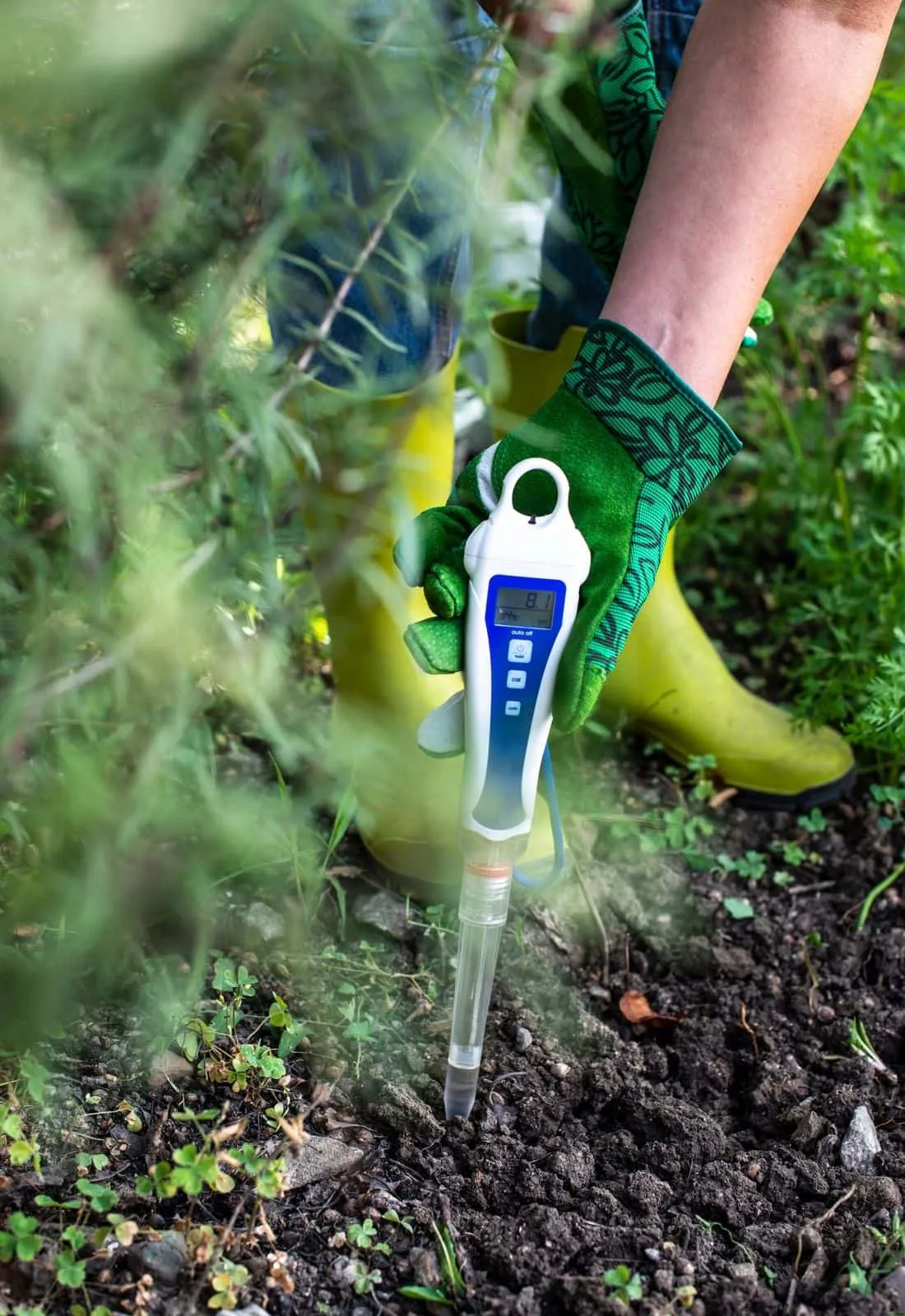
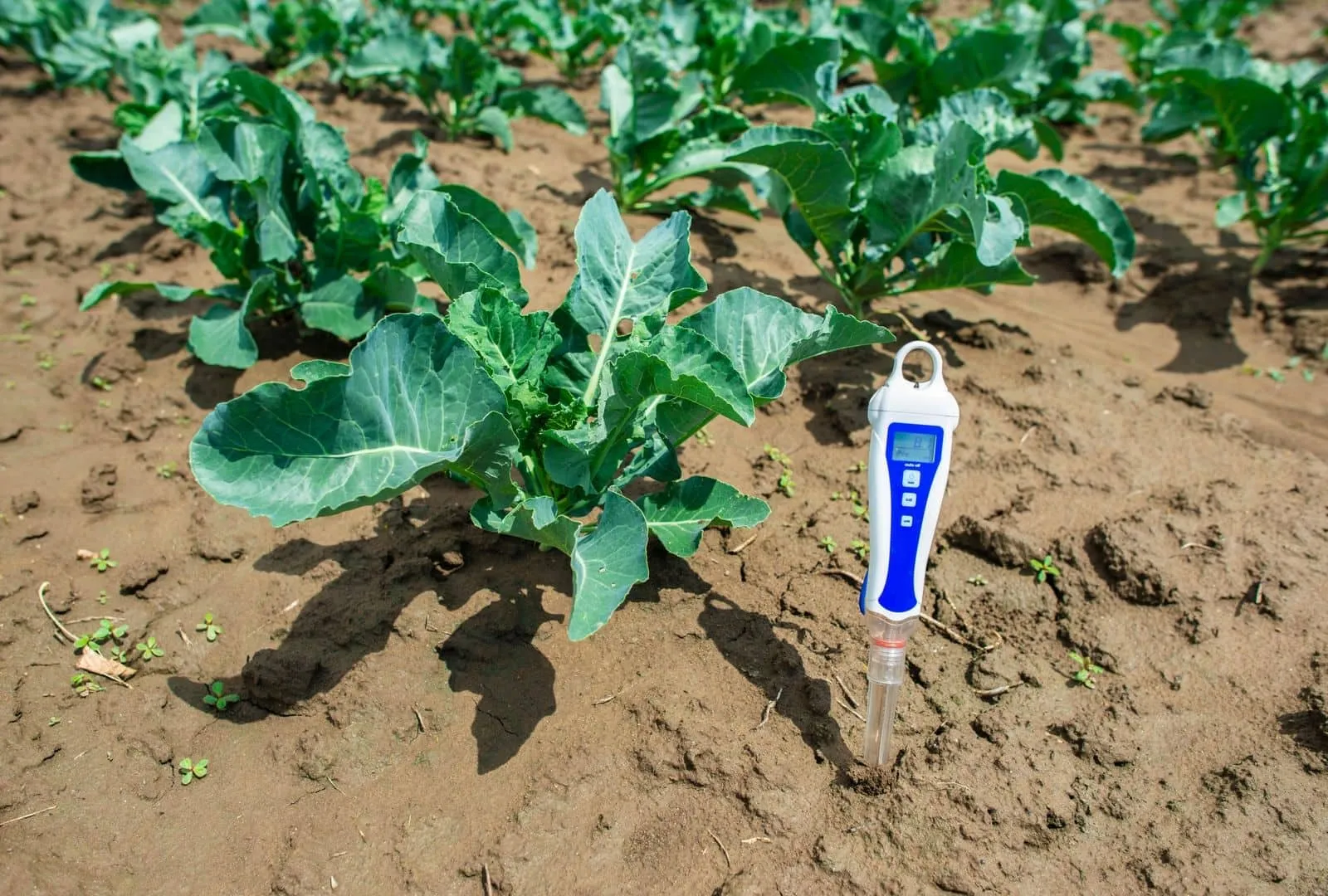
The pen in these photos is a Bluelab Soil pH Pen. For liquids, like the water from the drip test below, Bluelab also makes a pH pen for testing water.
Skip the two-prong tester. This is the cheap “soil pH tester” with two metal spikes, often sold as a 3-in-1 meter. In a University of Maryland test, two of them read plain peat up to 1.8 points too high. They read pH 4 liquid as above 10.[2] Purdue Extension also warns against pushing any sensor straight into potting mix.[3] Test a cup of mud or the drip water instead.
Soil pH test kit
A color test kit is cheap and lands within about 1 point of a lab test.[4]
- Fill the tube with soil to the first line.
- Add the powder.
- Add distilled water to the next line. Cap it and shake.
- Let it settle. Then match the color of the water to the chart.
Follow the wait times on your own kit. One point is the gap between 6.0 and 7.0, so treat the result as a rough guide. Some kit charts also stop at 7.5 and can’t show very chalky soil.
Soil pH test strips
Strips are quick but rough. Reading a color is guesswork, so a meter beats a strip.
- Stir 1 part soil into 2 parts distilled water.
- Wait for the soil to sink and the water on top to clear.
- Dip the strip in the clear water, not the mud.
- Match the color right away, in daylight.
How to test soil pH without a kit (vinegar and baking soda)
The vinegar test only shows soil that is very chalky or very sour. It gives no number.
- Put 2 spoonfuls of soil in each of 2 cups.
- In cup 1, add 1/2 cup of white vinegar. Vinegar is an acid that fizzes on chalk, so fizzing means chalky soil.
- In cup 2, add distilled water to make mud. Then add 1/2 cup of baking soda. Fizzing means very sour soil.
No fizz in either cup means the soil is in the middle, where almost every potting mix sits. So for a pot of herbs, this test tells you nothing new.
How to check the pH of a potted plant without digging it up
Test the water that drips out of the pot. Greenhouse growers use this drip test as a routine check.
- Water the pot as usual.
- Let it drain for 30 to 60 minutes.
- Set it on a clean saucer.
- Pour distilled water evenly over the top. For a 6.5-inch pot, use about 3.4 oz (100 ml), a little under 1/2 cup. You want about 1.7 oz (50 ml) to drip out.[3]
- Test that water with a pen meter or a strip.
What your soil pH number means (and what herbs need)
pH shows how acidic or alkaline soil is, on a scale from 0 to 14. 7 is neutral. Below 7 is acidic, or sour. Above 7 is alkaline, or chalky.
Soil at 5 is 10 times more acidic than soil at 6, so a 1-point miss is a big one.
At the wrong pH, plant food in the soil gets locked up. At high pH, iron locks up first. New leaves turn yellow while the veins stay green.[1]
| Plant or mix | Aim for |
|---|---|
| Most herbs: basil, mint, parsley, cilantro, chives, oregano, thyme, sage | 6.0 to 7.5, with about 6.5 as ideal |
| Rosemary | 6.5 to 7.0 |
| Lavender | 6.5 to 7.5 |
| Fresh bagged potting mix | Reads about 5.5 to 6.5, and that is normal |
Potting mix reads a little lower than garden soil, and herbs do fine in it. In a mix, plant food stays easy to reach from about 5.4 to 6.2.[3] So don’t add lime to a pot of basil at 5.8. Only lavender and rosemary want it nudged up.
What changes the pH of potting mix
The ingredients in the bag set the starting pH. After that, hard tap water slowly pushes it up, and some fertilizers pull it down.
| Ingredient | Its pH | What it does to a mix |
|---|---|---|
| Peat moss | 3.5 to 4.5 | Very sour. Bagged mixes add lime to fix it. |
| Coconut coir | 5.5 to 6.8 | Close to neutral. Needs no fixing. |
| Perlite | 7.0 to 7.5 | Doesn’t change the mix. |
| Vermiculite | 7.0 to 8.0 | Nudges a mix up a little. |
| Compost | Often above 7.0 | Nudges a mix up a little. |
How to raise soil pH
To raise soil pH, mix in garden lime. Dolomitic lime is the usual kind for pots. Only do this if a pot of herbs reads below 5.5, or lavender or rosemary reads below 6.5.
In a pot: stir a little under 1 tablespoon of lime into each gallon of mix when you pot up. If the pot is already planted, scratch the lime into the top inch and water it in. Lime works slowly, so wait 3 months before you test again.
In a garden bed: use the amount on your lab report, and test again in 3 to 6 months.
To raise pH fast: repot into fresh potting mix. Skip hydrated lime: it works faster, but it is harsh and easy to overdo. Skip baking soda too, since its salt builds up in a pot and harms roots.
How to lower soil pH
To lower soil pH in potted plants, repot into fresh mix and switch to rainwater or distilled water if your tap water is hard. In a garden bed, use elemental sulfur and be patient.
In a pot
High pH in a pot almost always comes from hard tap water. Fresh mix resets the pH the same day, and new water keeps it from creeping back.
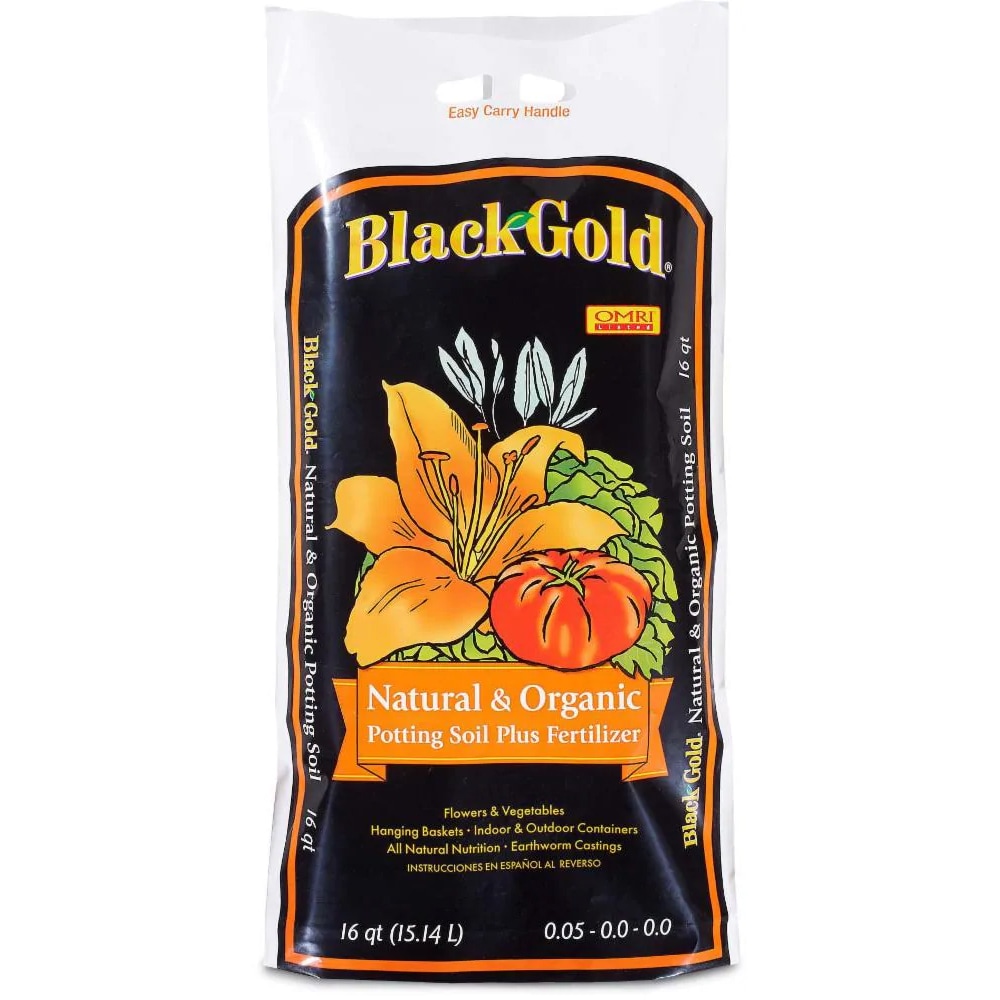
16-quart organic potting soil mix
- Provides retention advantage against sun exposure
- Contains organic grade fertilizer
- Contains enough soil for 1 cubic feet of space
In a garden bed
Use elemental sulfur at the rate on your lab report. Soil bacteria turn it into acid, which can take several months. Skip aluminum sulfate, since too much can injure roots.

Ten printable herb cards, free
One card per herb: how much light and water it wants, and what goes wrong first.
Get them nowQuestions & answers
Is a pH of 7.0 good for herbs?
Yes. 7.0 is neutral, and it sits inside the 6.0 to 7.5 range most herbs like. Lavender and rosemary are happy there too.
Do coffee grounds lower soil pH?
No. Used grounds are close to neutral, at about pH 6.5 to 6.8, and any change they cause soon fades.[5] Put them in your compost instead.
Are cheap soil pH testers accurate?
The two-prong kind is not. In a university test, it read pH 4 liquid as above 10.[2] The most accurate home tool is a glass-tip pen meter, set up with pH 4 and pH 7 liquid.
What are the signs of wrong soil pH in plants?
New leaves turn yellow while the veins stay green. The plant stays pale even after you feed it. Rule out too much water and too little light first, since both are far more common.
References
-
Purdue Extension HO-242-W, Alkalinity Management in Soilless Substrates. https://www.extension.purdue.edu/extmedia/ho/ho-242-w.pdf ↩︎ ↩︎
-
D.R. Hershey, University of Maryland, Evaluation of a metal probe pH meter, Ornamentals Northwest Archives 12(6), 1988. https://agsci.oregonstate.edu/sites/agscid7/files/horticulture/osu-nursery-greenhouse-and-christmas-trees/onn120620b.pdf ↩︎ ↩︎
-
Purdue Extension HO-237-W, pH and Electrical Conductivity Measurements in Soilless Substrates. https://www.extension.purdue.edu/extmedia/ho/ho-237-w.pdf ↩︎ ↩︎ ↩︎
-
South Dakota State University Extension, Are Cheap Home Garden Soil Test Kits Accurate? https://extension.sdstate.edu/are-cheap-home-garden-soil-test-kits-accurate ↩︎
-
Oregon State University Extension, Coffee grounds boost soil health, help control slugs. https://extension.oregonstate.edu/news/coffee-grounds-boost-soil-health-help-control-slugs ↩︎


