How to grow cilantro indoors

Written by Amanda Shiffler, M.Sc. Agronomy, B.Sc. Horticultural Science
Published · Updated · 9 min read
Some links below go to Amazon. If you buy through one, we earn a small commission at no extra cost to you.

Cilantro in short
Grows well either as a full-sized plant or as a microgreen. Direct seeding is recommended over transplanting, because cilantro dislikes root disturbance.
- Light
- Full sunAt least 6 hours full sun, or supplemental lighting
- Water
- Keep moistKeep the potting soil moist
- Temperature
- 50–85°F
- Difficulty
- Beginner
What usually goes wrong
Shoots up a thin central stalk and the new leaves come through fine and ferny
Fix: Keep it in the coolest bright spot in the house and sow a new pot every two or three weeks. Once the stalk is up, let it run. The seed it sets is coriander.
Sow cilantro seed directly into its final pot, because the taproot does not survive transplanting well.[1] Cover the seed a quarter inch, it germinates in the dark, expect sprouts in 7 to 10 days at 65 to 70°F,[2] and grow it cool: 65 to 70°F days, cooler nights, in six hours of sun or the equivalent under lights. The first cut comes 6 to 8 weeks after germination, a second follows about two weeks later, and then the plant is spent.[2] Sow a new pot every two to three weeks and the supply never gaps.
Cilantro divides a room like no other herb, and the divide is partly genetic: in a study of more than 14,000 people, a variant near the olfactory receptor gene OR6A2, which binds the aldehydes that give cilantro its smell, tracked with experiencing the herb as soapy.[3] If you are on the lucky side of that variant, cilantro takes to a windowsill readily, as full plants or as a tray of microgreens, provided you treat it as what it is: a fast, cool-season sprint that you re-run, not a houseplant that you keep.
Sow it where it will live
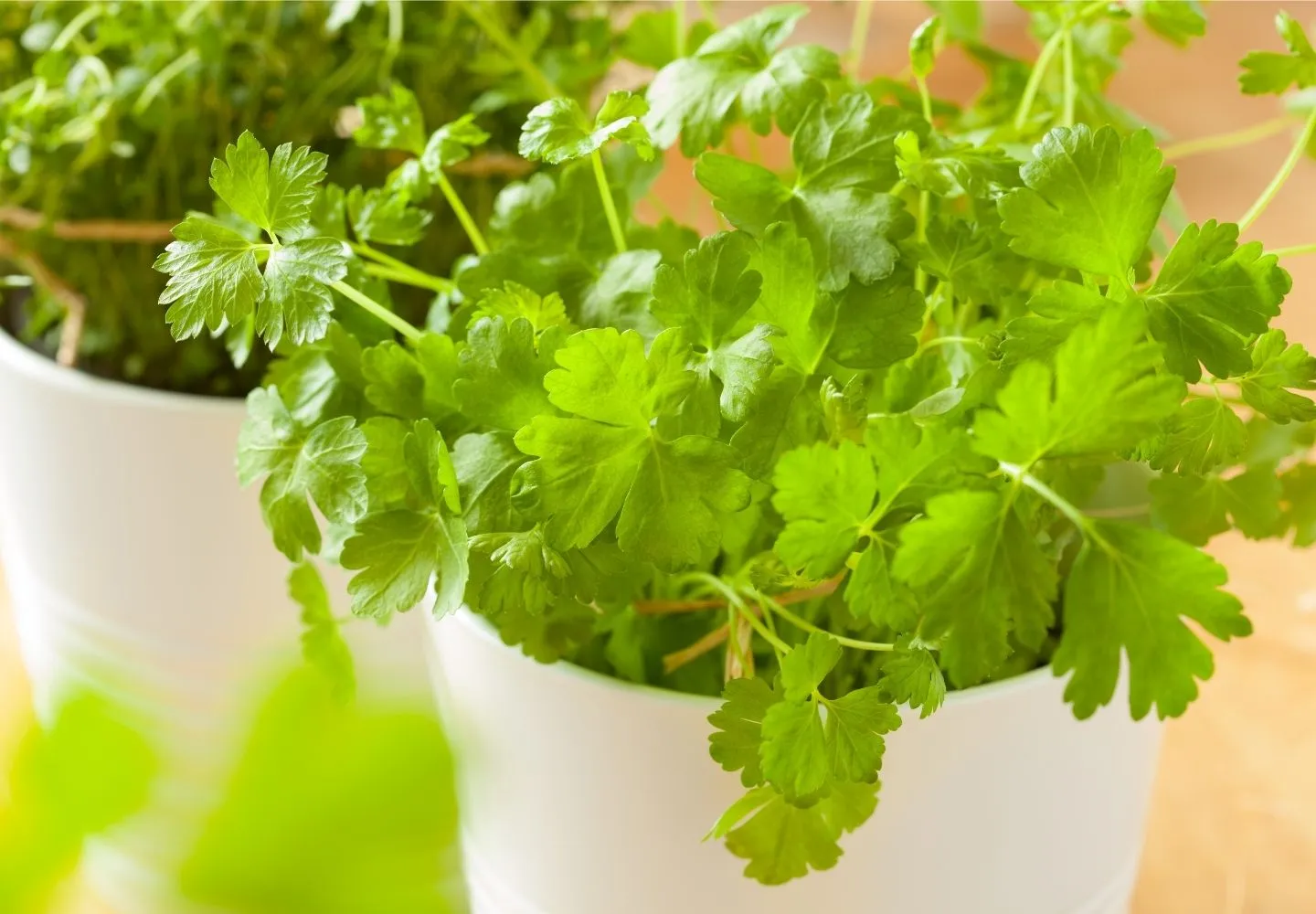
Every extension source repeats the same instruction, so take it seriously: cilantro grows a taproot and transplants badly, so it is direct-sown into the container it will die in.[1] Skip the seedling six-pack at the nursery; the checkout line is where those plants start bolting.
- Fill a deep pot, 8 inches for a single plant, 12 inches for three, with pre-moistened potting mix.
- Sow seeds a quarter inch deep and cover them fully. Unlike lettuce, cilantro germinates in darkness.[2]
- Keep the mix moist and the pot at 65 to 70°F; sprouts appear in 7 to 10 days, faster from “split” monogerm seed.[2]
- Thin to the strongest plant per 8-inch pot, or three well-spaced plants in a 12-inch container, once seedlings are about two inches tall.
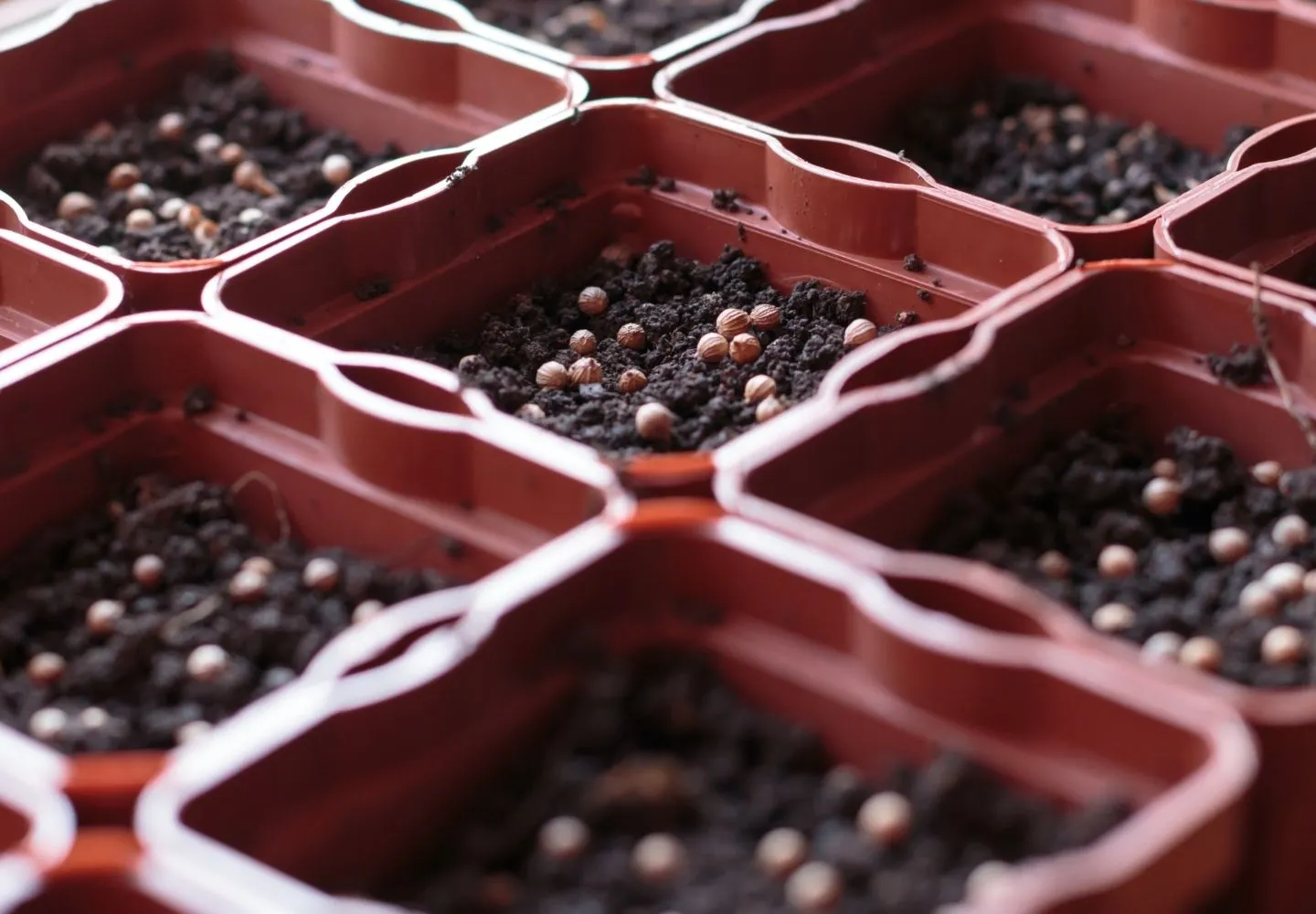
The rooting-a-stem-in-water trick you will see elsewhere is not worth your counter space for cilantro. No extension recommends it, and a rooted stem of a taprooted annual gives you a weak plant already leaning toward flower. Seed is cheap, fast and the entire commercial industry’s method.
The pot and the soil
Depth matters more than width here, the opposite of mint: the taproot wants somewhere to go. Plastic or glazed ceramic beats terra cotta because cilantro likes steady moisture, and the pot must drain. Any quality peat- or coir-based mix works; FoxFarm Ocean Forest is our standing pick, and the growing media guide covers alternatives. For pot selection generally, see our pot guide.
Light
Give it six hours of direct sun on a south or west sill if you have it. Cilantro is more forgiving than most, Penn State files it with the herbs that manage on two to six hours of direct sun,[4] but less light means slower, lankier growth, so treat six hours as the target and the tolerance as headroom.
Under grow lights, the standard herb schedule is 14 to 16 hours a day with the lamp 6 to 12 inches above the foliage.[4] With cilantro, favor the bottom of that range: it is a long-day plant, and stretching its days is one of the two signals that tell it to stop making leaves and flower.[5] Our lighting guide covers fixtures.
Temperature: the indoor advantage
Cilantro grows anywhere between 50 and 85°F, and bolts fast past the top of that range.[6] The indoor grower’s edge is control: Penn State’s indoor numbers, 65 to 70°F days and 55 to 60°F nights,[4] are exactly what a cool room does anyway. Keep the pot off sills that cook in afternoon sun and away from radiators; Utah State’s indoor guidance is to keep the soil itself below 75°F.[7] A cool, bright room is the single cheapest thing you can do to stretch the leaf phase.

The enthusiast’s guide to herbs
In-depth care cards for the 35 herbs people most often grow indoors.
See what’s insideWater and feeding
Keep the mix evenly moist and never let it dry out completely;[4] drought stress is a bolting trigger on top of being ordinary neglect. Water until it runs from the drainage holes, then let the surface just barely dry before going again.
Seedlings and dense sowings are damping-off targets, the fungal collapse that fells sprouts at the soil line. The prevention list is mechanical: clean containers, fresh sterile mix, bottom watering, and a little air movement from a cracked window or a small fan.[8]
Feed established plants a water-soluble fertilizer at low dose every two weeks.[4] Fish emulsion works well and is traditional for leafy herbs; be warned that its aroma in a closed kitchen is part of the tradition. Our fertilizer guide covers rates and alternatives.
The bolting clock
Cilantro’s reputation for quitting early is really a calendar. It is a long-day plant: both temperature and day length drive flowering, and a midsummer sowing bolts and sets seed within four to six weeks while the same seed sown into cooler, shorter days gives leaves for months.[5] Heat is the accelerator, above 85°F the switch flips fast,[6] but no windowsill is cool enough to cancel the program, only to slow it.
So plan around it rather than fighting it:
- Sow in succession. A new pot every two to three weeks means the replacement is always growing.[9]
- Buy slow-bolt genetics. ‘Calypso’ bolts about three weeks later than ‘Santo’; ‘Leisure’ and ‘Slow Bolt’ are the other proven names.[9]
- Let the last pot finish. A bolted plant left standing ripens seed, and that seed is the spice coriander: same plant, Coriandrum sativum, leaves sold as cilantro and dried seeds as coriander.[6] Collect the heads when they brown, and you have next month’s sowing plus a jar for the grinder.
Our bolting guide covers the mechanism in full.
Harvest: two cuts, then resow
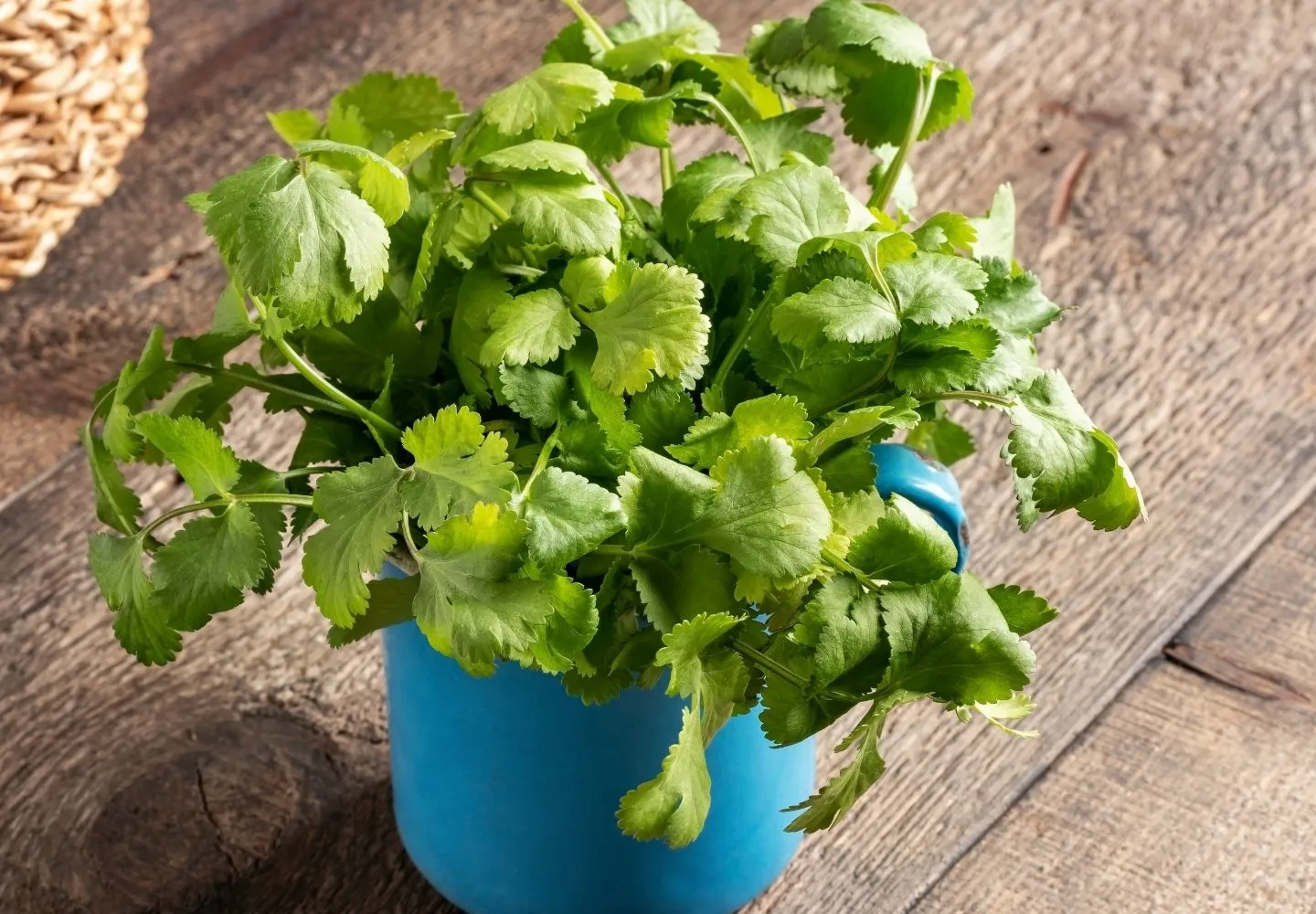
The old line that cilantro is not a cut-and-come-again herb undersells it slightly. Commercial growers plan on exactly two cuts: the first 6 to 8 weeks after germination, once plants stand about six inches, and a second 10 to 14 days later, after which the plant is done.[2]
For the first cut, either snip outer stems as their leaves reach 4 to 6 inches long,[6] or take up to a third of the plant at once, cutting stems near the base.[10] Pinch off any flower stems the moment they appear; it buys days, not weeks, but the days are worth having.[11]
Growing cilantro microgreens
If what you actually want is the flavor with none of the bolting drama, microgreens are the shortcut, and cilantro is one of the best-tasting trays you can grow.
The numbers, from Johnny’s yield trials: 26 grams of seed, a bit under an ounce, sown over a standard 10 by 20 inch tray returns about 6 ounces of microgreens in roughly 20 days, cut at the first true leaf.[12]
- Fill the tray with an inch or two of moist mix and scatter the seed evenly across the whole surface.
- Do not cover with mix. Instead, stack a second tray on top with a weight in it; the pressure and darkness suit the seed and anchor the roots.
- After 24 hours, begin misting daily. Keep the surface damp, never flooded, and err dry: dense sowings are damping-off country.[8]
- Uncover once sprouts push the top tray, give them light, and harvest with scissors at 2 to 3 inches.

Bootstrap Farmer 1020 trays, 2.5 in deep, no drainage holes
- 2.5 inches deep, so a taproot has somewhere to go
- Solid base with no drainage holes, so the tray doubles as a water reservoir
- Food-safe BPA-free polypropylene, made to be reused rather than replaced
Our microgreens guide covers the method across crops.
Worth knowing at the counter
Cilantro is one of the oldest herbs in the human record: desiccated coriander fruits from Nahal Hemar Cave in Israel date to roughly 6000 BCE, and a half litre of coriander went into Tutankhamun’s tomb.[13] The modern health literature is thinner than the history; lab studies point at antioxidant activity, and human evidence has not caught up,[14] so grow it for the salsa.
Questions & answers
Does cilantro grow back after you cut it?
Once, usually. Plan on two harvests: a first cut when the plant reaches about six inches, and a second 10 to 14 days later, which is the commercial norm.[2] After that the plant runs to flower and the leaves stop coming. That is why the working method is a new pot every two to three weeks rather than one cherished plant.
How long does an indoor cilantro plant last?
From sowing: 7 to 10 days to germinate, six to eight weeks to first harvest, and about two more weeks to the final cut,[2] call it three months end to end in a cool room, less in a warm one. The plant’s lifespan is fixed by its bolting program; your levers are coolness, moisture, and pinching flower stems.
Can you grow cilantro from grocery store stems?
As a novelty only. Stems will sometimes root in water, but no extension service recommends it, and the result is a weak, short-lived plant already primed to bolt. A packet of seed costs less than a supermarket bunch and out-produces it many times over.
Why is my indoor cilantro leggy and falling over?
Not enough light for the temperature it is growing at. Warm and dim is the stretching combination: move it to your brightest sill or add a grow light, and keep the room cool so growth stays dense.[4] Plants sown too thickly also prop each other up and then flop when thinned late; thin early instead.
Can you grow cilantro indoors year-round?
Yes, and winter is the easy season: cool rooms and short days are exactly what cilantro wants. The discipline is succession, a new pot every two to three weeks, plus a grow light run at moderate day length when the sun is weak.[9] Summer pots on hot sills bolt fastest; give them the coolest bright spot you have.
Why does cilantro taste like soap to some people?
Partly genetics. A study of over 14,000 people linked a variant near the olfactory receptor gene OR6A2, which detects the aldehydes in cilantro’s aroma, to perceiving it as soapy.[3] If that is you, no growing advice will help, but the seeds still become coriander, which soap-tasters usually enjoy fine.
Cilantro’s succession rhythm pairs naturally with other fast crops: lettuce works the same resow-and-repeat way, and microgreens compress the whole idea into three weeks. For the herbs that punish this kind of impatience instead, start with rosemary.

Ten printable herb cards, free
One card per herb: how much light and water it wants, and what goes wrong first.
Get them nowReferences
-
Oregon State University Extension, How to grow cilantro for leaves or coriander for seeds (“its long taproot makes transplanting difficult”): https://extension.oregonstate.edu/news/how-grow-cilantro-leaves-or-coriander-seeds; University of Illinois Extension, Cilantro: https://extension.illinois.edu/herbs/cilantro ↩︎ ↩︎
-
Johnny’s Selected Seeds, Cilantro production guide (#8306): direct seeding recommended; dark germination; emergence 7–10 days at 65–70°F; split seed faster; two cuts, the first 6–8 weeks after germination, the second 10–14 days later. https://www.johnnyseeds.com/on/demandware.static/-/Library-Sites-JSSSharedLibrary/default/dwd4559419/assets/information/8306-cilantro-production.pdf ↩︎ ↩︎ ↩︎ ↩︎ ↩︎ ↩︎ ↩︎
-
Eriksson, N. et al. (2012). A genetic variant near olfactory receptor genes influences cilantro preference. Flavour, 1, 22. https://doi.org/10.1186/2044-7248-1-22 ↩︎ ↩︎
-
Penn State Extension. Growing herbs indoors: six hours of direct sun or 14–16 hours under lights 6–12 inches away; 65–70°F days, 55–60°F nights; low-dose water-soluble feed every two weeks; never let cilantro’s mix dry completely. https://extension.psu.edu/growing-herbs-indoors ↩︎ ↩︎ ↩︎ ↩︎ ↩︎ ↩︎
-
Oregon State University Extension. Plant cilantro in summer to get coriander seeds: temperature and day length jointly drive flowering; midsummer sowings bolt within four to six weeks. https://extension.oregonstate.edu/news/plant-cilantro-summer-get-coriander-seeds ↩︎ ↩︎
-
Texas A&M AgriLife Extension, E-277, Cilantro: growth between 50 and 85°F, bolting above 85°F; harvest exterior leaves at 4–6 inches; leaves as cilantro, seeds as coriander. https://aggie-horticulture.tamu.edu/vegetable/wp-content/uploads/sites/10/2010/10/E-277_cilantro.pdf ↩︎ ↩︎ ↩︎ ↩︎
-
Utah State University Extension. Cilantro/coriander in the garden and indoor growing FAQ: keep container soil below 75°F near heat sources and warm windows. https://extension.usu.edu/yardandgarden/research/cilantro-coriander-in-the-garden ↩︎
-
University of Minnesota Extension. How to prevent seedling damping off: Rhizoctonia, Fusarium and Pythium; sterile mix, clean containers, bottom watering, airflow. https://extension.umn.edu/solve-problem/how-prevent-seedling-damping ↩︎ ↩︎
-
Penn State Extension. Cilantro: a unique culinary herb: succession sowing, and cultivars ‘Slow Bolt’, ‘Leisure’, ‘Santo’ and ‘Calypso’, the last about three weeks slower to bolt than ‘Santo’. https://extension.psu.edu/cilantro-a-unique-culinary-herb ↩︎ ↩︎ ↩︎
-
Penn State’s harvest rule for cilantro: cut one-third of the plant at ground level per harvest once it reaches six inches (same source as above). ↩︎
-
University of Maryland Extension. Cilantro (coriander): harvest from six inches; pinching off flower stems extends the harvest. https://extension.umd.edu/resource/cilantrocoriander ↩︎
-
Johnny’s Selected Seeds. Micro greens yield trial: cilantro at 26 g seed per 1020 tray, average yield 6 oz, about 20 days to first-true-leaf harvest. https://www.johnnyseeds.com/growers-library/vegetables/microgreens/micro-greens-yield-trial-results-tech-sheet.html ↩︎
-
Zohary, D. and Hopf, M. (2000). Domestication of Plants in the Old World, 3rd ed., Oxford University Press, p. 206, citing Kislev (1988) on the Nahal Hemar Cave coriander finds. ↩︎
-
Singletary, K. (2016). Coriander: overview of potential health benefits. Nutrition Today, 51(3), 151–161. https://doi.org/10.1097/NT.0000000000000159 ↩︎


